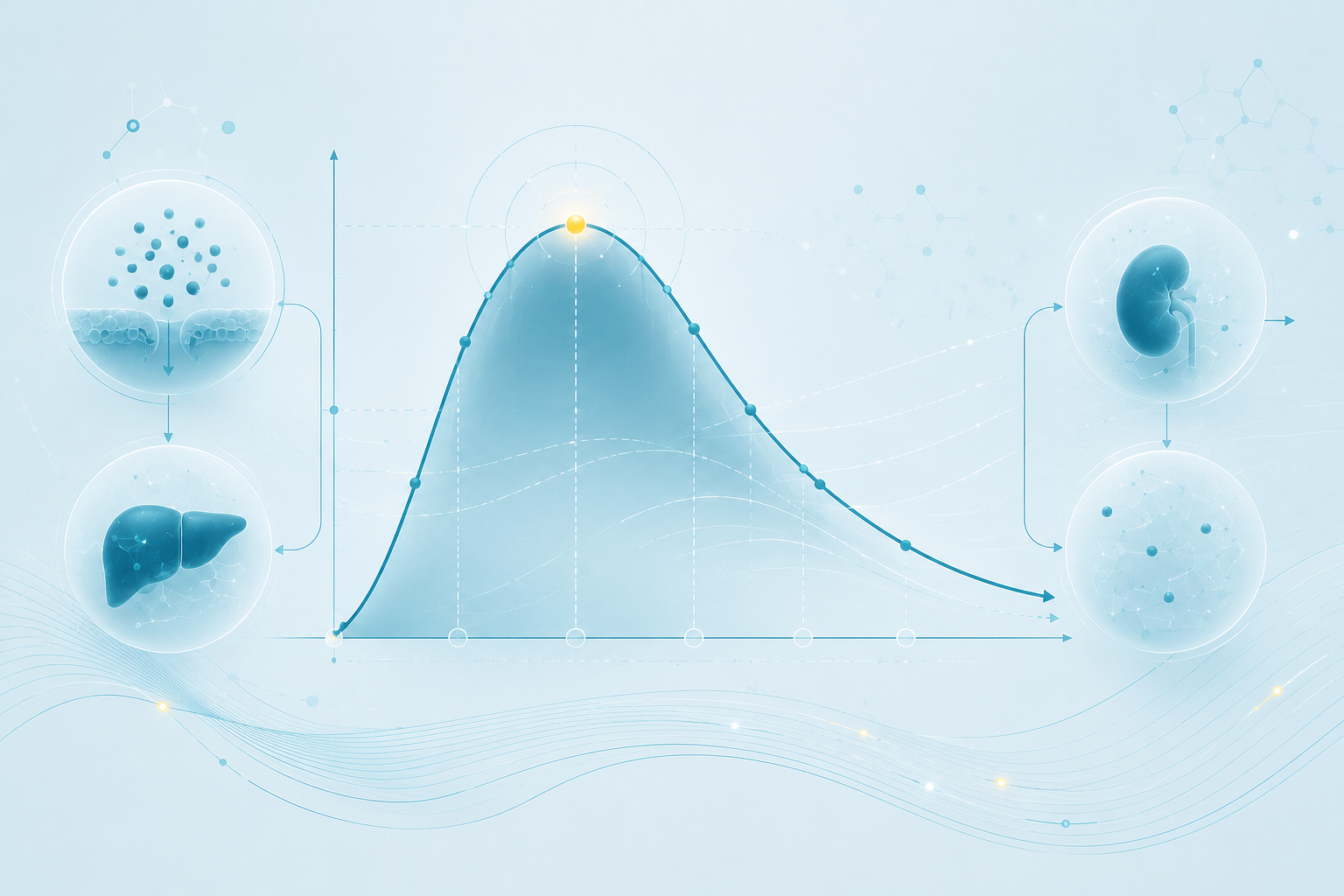
A comprehensive, pharmacology‑focused overview of Dapoxetine’s absorption, distribution, metabolism, and
elimination (ADME), explaining why its PK profile is uniquely optimized for on‑demand treatment of premature
ejaculation.
Dapoxetine is absorbed rapidly after oral administration, reaching peak plasma concentration within 1–2 hours.
This fast absorption, combined with high affinity for the serotonin transporter, explains its rapid onset of
action. The drug distributes efficiently into central nervous system tissues, enabling quick engagement of
serotonergic pathways involved in ejaculatory control.
Metabolism occurs primarily through CYP2D6 and CYP3A4, producing inactive metabolites that are cleared quickly.
The elimination half‑life is unusually short for an SSRI, preventing accumulation and allowing Dapoxetine to be
used situationally rather than chronically. This transient exposure minimizes persistent serotonergic effects
and reduces the risk of long‑term SSRI‑type adverse reactions.
The PK profile also explains why Dapoxetine has a favorable safety margin: rapid clearance limits systemic
burden, while high peak concentration provides strong but temporary therapeutic activity. Food has minimal
impact on overall exposure, making dosing flexible. Differences between 30 mg and 60 mg are proportional, with
higher doses producing greater peak levels but following the same ADME pathway.
These pharmacokinetic characteristics — fast absorption, efficient CNS distribution, rapid metabolism, and short
half‑life — collectively define why Dapoxetine works quickly, avoids accumulation, and maintains a cleaner
safety profile than traditional SSRIs. For deeper context, explore:
MOA,
Dosage,
Onset & Duration.
Dapoxetine is characterized by rapid and efficient absorption, a defining feature that supports its use
as
an on‑demand therapy for premature ejaculation. After oral administration, the drug is quickly taken up
through the gastrointestinal tract, reaching systemic circulation within a short timeframe. This fast
uptake
enables Dapoxetine to achieve its peak plasma concentration (Tmax) within 1–2 hours, aligning
closely with the period during which patients require therapeutic activity. The rapid rise in plasma
levels
directly contributes to early enhancement of serotonergic signaling and the fast onset of clinical
effect.
The medication demonstrates high oral bioavailability, ensuring that a substantial proportion of the
administered dose reaches systemic circulation in active form. This efficient absorption supports
predictable pharmacokinetics across both the 30 mg and 60 mg doses, allowing clinicians and patients to
rely
on consistent timing and effect.
Food intake—particularly high‑fat meals—can influence Dapoxetine’s absorption profile. Studies show that
fatty meals may increase both Cmax (peak plasma concentration) and AUC (overall exposure).
While
these changes reflect enhanced absorption, their clinical significance is minimal, as they do not
meaningfully alter onset, efficacy, or safety. This means Dapoxetine can be taken with or without food,
offering flexibility in real‑world use.
Overall, the absorption characteristics of Dapoxetine—fast uptake, predictable Tmax, and
minimal
clinically relevant food effects—form the foundation of its rapid onset of action. These properties
distinguish it from traditional SSRIs, which require prolonged dosing to achieve therapeutic levels, and
reinforce its suitability for on‑demand administration.
Dapoxetine exhibits high lipophilicity, a property that enables the molecule to rapidly cross biological
membranes and distribute widely throughout the body. This lipophilic nature contributes to a relatively
large volume of distribution, indicating that the drug moves extensively beyond the vascular compartment
into tissues. Such broad distribution supports its fast engagement with central serotonergic pathways,
reinforcing the rapid onset of action characteristic of on‑demand therapy.
A significant portion of circulating Dapoxetine is bound to plasma proteins, primarily albumin and α‑1‑acid
glycoprotein. High protein binding helps stabilize plasma concentrations and prolongs the presence of the
active compound in systemic circulation during the therapeutic window. Despite this, the drug’s overall
pharmacokinetic profile remains short‑acting due to rapid metabolism and clearance.
Importantly, Dapoxetine is capable of penetrating the central nervous system (CNS), where it modulates
spinal and supraspinal centers involved in ejaculatory control. This CNS penetration is essential for its
mechanism of action, as serotonergic modulation within these pathways directly increases intravaginal
ejaculatory latency time (IELT). The combination of fast distribution and CNS accessibility explains why
Dapoxetine produces clinical effects within hours rather than weeks, unlike traditional SSRIs.
Overall, Dapoxetine’s distribution profile—marked by lipophilicity, extensive tissue penetration, and CNS
access—plays a central role in its rapid pharmacodynamic response and suitability for on‑demand use.
Distribution Characteristics
Parameter
Value
Clinical Significance
Lipophilicity
High
Enables rapid membrane crossing and CNS penetration
Volume of distribution
Large
Indicates extensive tissue distribution
Protein binding
High
Stabilizes plasma levels during therapeutic window
CNS penetration
Present
Essential for modulation of ejaculatory pathways
Metabolism
Dapoxetine undergoes extensive hepatic metabolism, primarily through the cytochrome P450 system. The major
enzymes involved are CYP3A4, CYP2D6, and CYP2C19, each contributing to different stages of
biotransformation. CYP3A4 is the dominant pathway, responsible for converting a substantial portion of the
parent compound into downstream metabolites. CYP2D6 and CYP2C19 provide secondary metabolic routes,
contributing to inter‑individual variability in exposure and clinical response.
The metabolic process produces several primary metabolites, including desmethyldapoxetine and various
conjugated derivatives. Most of these metabolites are inactive, meaning they do not contribute to the
therapeutic effect on ejaculatory control. A small subset exhibits weak pharmacological activity, but their
contribution is clinically negligible due to low systemic concentrations. The predominance of inactive
metabolites is one of the reasons Dapoxetine maintains a short elimination half‑life, as the parent compound
is rapidly cleared and does not accumulate with intermittent use.
The reliance on CYP3A4 has important clinical implications. Co‑administration with strong CYP3A4
inhibitors—such as ketoconazole, ritonavir, or certain macrolides—can significantly increase Dapoxetine
plasma levels. This elevation raises the risk of adverse effects, including dizziness, nausea, and syncope,
particularly during the peak concentration window. For this reason, dose adjustments or avoidance of strong
inhibitors may be necessary in clinical practice.
Overall, Dapoxetine’s metabolic profile—rapid hepatic processing, formation of largely inactive metabolites,
and dependence on CYP3A4—explains its short T½, minimal accumulation, and suitability for on‑demand use.
These characteristics also underscore the importance of evaluating potential drug–drug interactions when
prescribing Dapoxetine.
For interaction‑related guidance, see
Interactions.
Metabolic Pathways
Enzyme
Role
Clinical Significance
CYP3A4
Primary metabolic pathway
Inhibitors ↑ exposure; interaction risk highest
CYP2D6
Secondary metabolism
Genetic variability may affect plasma levels
CYP2C19
Minor metabolic contribution
Limited clinical impact
Elimination
Dapoxetine is cleared from the body rapidly, a defining pharmacokinetic characteristic that supports its use
as an on‑demand therapy. After absorption and distribution, the parent compound undergoes swift hepatic
metabolism followed by excretion through both renal and biliary pathways. This efficient clearance results
in a short elimination half‑life (T½ 1.5–2.5 hours), which is significantly shorter than that of traditional
SSRIs. The rapid decline in plasma concentration ensures that the drug’s pharmacological activity remains
confined to a narrow therapeutic window aligned with anticipated sexual activity.
Because Dapoxetine is eliminated so quickly, it demonstrates no meaningful accumulation, even when taken
repeatedly within recommended dosing intervals. This absence of buildup reduces the risk of persistent
serotonergic adverse effects, such as emotional blunting or chronic sexual dysfunction, which are more
commonly associated with long‑acting SSRIs. The short T½ also contributes to a favorable safety profile, as
systemic exposure declines soon after the therapeutic effect has been achieved.
Elimination occurs through a combination of hepatic metabolism and renal excretion of metabolites. While the
liver plays the primary role in biotransformation, the kidneys contribute to the removal of inactive
metabolites. This dual‑pathway clearance supports predictable pharmacokinetics across different patient
populations, provided that severe hepatic impairment is not present.
Clinically, the short elimination half‑life is central to Dapoxetine’s design: it provides strong,
time‑limited serotonergic modulation without long‑term exposure, making the medication both effective and
safe for intermittent use.
Elimination Parameters
Parameter
Value
Comment
Elimination half‑life (T½)
1.5–2.5 hours
Explains rapid offset and lack of accumulation
Accumulation
None
Supports safe on‑demand use
Primary clearance
Hepatic metabolism
Fast biotransformation of parent compound
Secondary clearance
Renal excretion
Removal of inactive metabolites
Half‑Life & Clinical Implications
Dapoxetine’s short elimination half‑life (T½ 1.5–2.5 hours) is one of the defining features that shapes its
clinical behavior and suitability for on‑demand use. Because the drug is cleared rapidly after reaching peak
plasma concentration, its pharmacological activity remains tightly confined to the therapeutic window
surrounding sexual activity. This allows patients to take Dapoxetine only when needed, without the
continuous exposure required for traditional SSRIs.
The short T½ also contributes to a lower risk of side effects compared with long‑acting serotonergic agents.
Since the drug does not accumulate in the body, systemic serotonin levels return to baseline relatively
quickly, reducing the likelihood of persistent adverse effects such as insomnia, emotional blunting, or
chronic sexual dysfunction. This transient exposure is particularly important for men who prefer to avoid
long‑term neurochemical adaptation associated with daily antidepressants.
Another key implication of the short half‑life is the reduced potential for drug–drug interactions. Because
Dapoxetine is present in the system for a limited duration, the window during which interactions can occur
is much smaller than with SSRIs that maintain steady‑state concentrations. While caution is still required
with strong CYP3A4 inhibitors, the overall interaction risk is lower due to rapid clearance and minimal
accumulation.
Together, these characteristics make Dapoxetine uniquely optimized for intermittent use: fast in, fast out,
clinically effective, and less likely to produce long‑lasting adverse effects or complex interaction
profiles.
Elimination Parameters
Parameter
Value
Comment
Half‑life (T½)
1.5–2.5 hours
Supports on‑demand dosing
Accumulation
None
Lower risk of persistent side effects
Interaction window
Short
Reduced likelihood of drug–drug interactions
PK Differences: 30 mg vs 60 mg
The pharmacokinetic profile of Dapoxetine demonstrates clear dose proportionality between the 30 mg and 60
mg strengths. As the dose increases, both Cmax (peak plasma concentration) and AUC (overall
systemic exposure) rise in a predictable, linear manner. This proportionality ensures that clinicians can
anticipate the magnitude of pharmacodynamic effects when escalating from 30 mg to 60 mg, particularly in
patients who require stronger serotonergic modulation to achieve adequate ejaculatory control.
The Cmax of the 60 mg dose is significantly higher than that of 30 mg, reflecting a more intense
but still time‑limited serotonergic effect during the therapeutic window. Similarly, the AUC nearly doubles,
indicating greater overall exposure without altering the drug’s short elimination half‑life. Importantly,
despite the increased exposure, Dapoxetine does not accumulate due to its rapid clearance, maintaining a
favorable safety profile even at the higher dose.
Clinically, these PK differences translate into a stronger and more consistent increase in IELT with the 60
mg dose, making it appropriate for men who do not achieve sufficient benefit from 30 mg. At the same time,
the proportional rise in exposure helps preserve predictability in onset, duration, and tolerability. This
balance between efficacy and safety is central to Dapoxetine’s design as an on‑demand therapy.
PK Comparison: 30 mg vs 60 mg
Parameter
30 mg
60 mg
Difference
Cmax
Moderate
Higher
~2× increase
AUC
Baseline exposure
Increased exposure
~2× increase
Half‑life
1.5–2.5 hours
1.5–2.5 hours
No change
Clinical effect
2–3× IELT increase
3–4× IELT increase
Stronger efficacy
Food Effect
The absorption of Dapoxetine can be influenced by high‑fat meals, which tend to increase both
Cmax (peak plasma concentration) and AUC (overall systemic exposure). This occurs because fatty
foods slow gastric emptying and enhance the solubility of lipophilic compounds, allowing a slightly greater
fraction of the dose to enter systemic circulation. As a result, plasma levels may rise modestly higher and
remain elevated for a slightly longer period during the early post‑dose window.
Despite these measurable pharmacokinetic changes, the clinical significance is minimal. The increases in
Cmax and AUC do not meaningfully alter onset, efficacy, or tolerability. Dapoxetine still reaches
therapeutic concentrations within the expected timeframe, and its short half‑life ensures that overall
exposure remains time‑limited. This means patients can take the medication with or without food without
compromising effectiveness.
The reason the food effect remains moderate is tied to Dapoxetine’s rapid absorption and fast clearance.
Even when exposure increases slightly, the drug does not accumulate, and the therapeutic window remains
predictable. This stability supports flexible dosing and reinforces Dapoxetine’s suitability for on‑demand
use.
Food Effect on Absorption
Parameter
Effect
Comment
Cmax
↑ Moderate increase
Does not change onset or efficacy
AUC
↑ Slight increase
Minimal clinical relevance
Overall impact
Low
Safe with or without food
PK vs Traditional SSRIs
Dapoxetine differs fundamentally from traditional SSRIs in its pharmacokinetic profile, which eliminates the
need for drug accumulation. Because Dapoxetine is absorbed rapidly, reaches peak plasma concentration within
1–2 hours, and has a short elimination half‑life, it delivers its therapeutic effect during a narrow,
predictable window. This allows patients to take it on‑demand, only before sexual activity, without
requiring continuous daily dosing.
In contrast, SSRIs such as sertraline and paroxetine require weeks of daily administration to reach
steady‑state levels. Their long half‑lives and slow receptor‑level adaptations mean that therapeutic effects
emerge only after prolonged exposure. This makes them unsuitable for on‑demand use, as their mechanism
depends on gradual neurochemical changes rather than rapid serotonergic modulation.
Dapoxetine’s short half‑life also contributes to a safer profile for intermittent use. Because it clears
quickly, it does not accumulate, reducing the risk of persistent serotonergic side effects such as emotional
blunting, insomnia, or chronic sexual dysfunction—effects more commonly associated with long‑acting SSRIs.
Additionally, the limited exposure window reduces the likelihood of drug–drug interactions, although caution
is still required with strong CYP3A4 inhibitors.
Together, these PK differences explain why Dapoxetine is uniquely suited for rapid, targeted modulation of
ejaculatory pathways, while traditional SSRIs remain long‑term antidepressant therapies with delayed onset
and higher accumulation‑related risks.
PK Comparison: Dapoxetine vs SSRIs
Parameter
Dapoxetine
Sertraline/Paroxetine
Onset of action
1–2 hours
2–6 weeks
Half‑life
1.5–2.5 hours
Long (20–30+ hours)
Accumulation
None
Significant
Use pattern
On‑demand
Daily therapy
Clinical purpose
Increase IELT
Treat depression/anxiety
PK Summary
Dapoxetine’s pharmacokinetic profile is defined by rapid and predictable ADME characteristics that directly
support its clinical performance. The drug is absorbed quickly, reaching peak plasma concentration within
1–2 hours; distributed widely due to high lipophilicity; metabolized efficiently through CYP3A4, CYP2D6, and
CYP2C19; and eliminated with a short half‑life of 1.5–2.5 hours. These combined properties ensure fast
onset, minimal accumulation, and a tightly controlled exposure window.
These PK features are central to Dapoxetine’s effectiveness. Rapid absorption and CNS penetration allow
immediate engagement of serotonergic pathways regulating ejaculation, while dose‑proportional exposure
ensures predictable increases in IELT at both 30 mg and 60 mg. The short half‑life ensures that the
pharmacodynamic effect aligns precisely with the therapeutic window required for on‑demand use.
At the same time, the PK profile underpins Dapoxetine’s safety advantages. Fast clearance prevents drug
accumulation, reducing the risk of persistent serotonergic adverse effects commonly associated with
long‑acting SSRIs. The limited exposure window also narrows the timeframe for potential drug–drug
interactions, making the medication safer for intermittent use, provided strong CYP3A4 inhibitors are
avoided.
Together, these ADME characteristics create a pharmacokinetic design optimized for rapid, targeted, and
reversible action—precisely what is required for an effective on‑demand therapy for premature ejaculation.
Dapoxetine is absorbed rapidly after oral administration, reaching peak plasma
concentration (Tmax) within approximately 1–2 hours. This fast absorption is one of the
defining features of its pharmacokinetic profile and directly contributes to its rapid
onset of action. Unlike traditional SSRIs, which require days or weeks to accumulate,
Dapoxetine achieves effective SERT inhibition shortly after dosing. The rapid rise in
plasma levels allows it to be used on-demand, making it uniquely suited for situational
treatment of premature ejaculation.
Food has minimal impact on the overall pharmacokinetics of Dapoxetine. While a high-fat
meal may slightly delay Tmax or modestly alter Cmax, these changes are not clinically
significant and do not meaningfully affect onset or efficacy. Because exposure (AUC)
remains largely unchanged, Dapoxetine can be taken with or without food. This
flexibility
supports its on-demand use and ensures consistent performance across different dosing
conditions.
Dapoxetine was intentionally engineered with a short elimination half-life to prevent
accumulation and allow safe, situational use. After reaching peak levels, the drug is
rapidly metabolized and cleared, resulting in a terminal half-life of only a few hours.
This design minimizes prolonged serotonergic exposure and reduces the risk of persistent
SSRI-type adverse effects. The short half-life is a key reason Dapoxetine can deliver
strong therapeutic action during a narrow window while avoiding long-term systemic
burden.
No. Due to its short half-life and rapid clearance, Dapoxetine does not accumulate with
repeated dosing. Plasma concentrations fall quickly after the therapeutic window, and
the drug does not build up in tissues the way traditional SSRIs do. This lack of
accumulation is central to its safety profile: it avoids chronic serotonergic effects,
reduces long-term adverse reactions, and supports flexible, on-demand use without
requiring daily administration.
Dapoxetine undergoes extensive first-pass metabolism, primarily through oxidative
pathways. The major metabolic routes involve CYP2D6 and CYP3A4, which convert the parent
compound into inactive metabolites. Additional conjugation pathways further facilitate
elimination. Because metabolism is rapid and efficient, active drug levels decline
quickly after peak exposure. This metabolic profile contributes to Dapoxetine’s short
half-life, low accumulation, and favorable tolerability compared with long-acting SSRIs.
The primary enzymes responsible for Dapoxetine metabolism are CYP2D6 and CYP3A4. CYP2D6
plays a major role in converting the parent compound into desmethylated metabolites,
while CYP3A4 contributes to additional oxidative pathways. Minor involvement of other
enzymes and conjugation systems supports rapid clearance. Variability in CYP2D6 activity
can influence exposure, but because the drug is short-acting and used on-demand, these
differences rarely lead to clinically significant accumulation.
The pharmacokinetic mechanism is identical at both doses, but exposure is
dose-proportional. The 60 mg dose produces higher Cmax and AUC values, resulting in
stronger serotonergic modulation during the therapeutic window. However, absorption,
metabolism, and elimination follow the same ADME pathway. Because the half-life remains
short at both doses, neither strength leads to accumulation. The difference is simply
the magnitude of peak exposure, not the underlying PK behavior.
Yes. Dapoxetine crosses the blood–brain barrier efficiently, which is essential for its
therapeutic effect. After rapid absorption, the drug distributes into central nervous
system tissues where it inhibits the serotonin transporter (SERT). This central
penetration allows Dapoxetine to modulate the spinal and supraspinal circuits involved
in ejaculatory control. The ability to reach CNS targets quickly is a key reason for its
fast onset of action compared with traditional SSRIs.
Dapoxetine is eliminated primarily through hepatic metabolism followed by renal
excretion of its inactive metabolites. Because the parent compound is rapidly broken
down, only small amounts remain in circulation after the therapeutic window. This fast
elimination prevents accumulation and contributes to the drug’s short half-life. The
elimination pathway is efficient even at higher doses, supporting consistent clearance
across different dosing conditions.
Dapoxetine’s safety advantage comes from its pharmacokinetics. The drug is absorbed
quickly, acts strongly during a short window, and is cleared rapidly. This prevents
long-term serotonergic exposure, which is responsible for many chronic SSRI side
effects. Because Dapoxetine does not accumulate, it avoids persistent receptor
adaptations and minimizes systemic burden. The result is a cleaner, more predictable
safety profile tailored for on-demand use rather than continuous daily therapy.